SpaceX's 34th Resupply Mission: Key Science and Logistics for the ISS
NASA and SpaceX are gearing up for the 34th commercial resupply mission to the International Space Station (ISS), set to launch in mid-May. This mission will deliver over 6,500 pounds of vital supplies and cutting-edge scientific experiments aboard a Dragon spacecraft atop a Falcon 9 rocket. From studies simulating microgravity to monitoring space weather and dust particle dynamics, the payloads aim to advance both deep-space exploration and life on Earth. Below, we answer your top questions about this pivotal flight.
What is the primary goal of NASA’s SpaceX 34th commercial resupply mission?
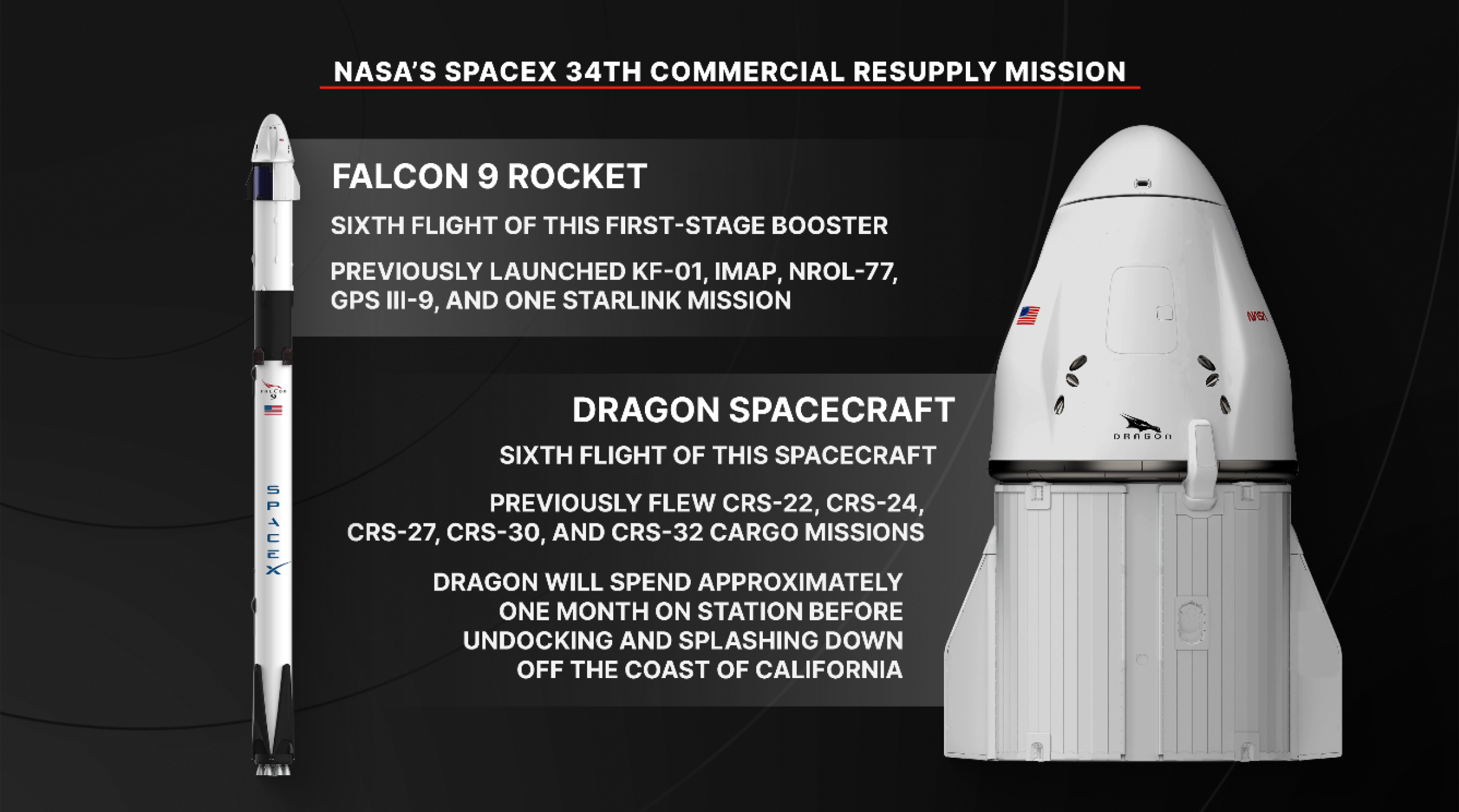
This mission is part of NASA’s ongoing partnership with SpaceX to transport essential cargo, research equipment, and scientific investigations to the ISS. The Dragon spacecraft will carry approximately 6,500 pounds of supplies, including crew provisions, hardware, and several unique experiments. The flight supports the station’s operations and enables groundbreaking research in microgravity, which can further NASA’s Artemis program for lunar missions and future journeys to Mars. More than 4,000 experiments have been conducted aboard the ISS over 25 years, and this mission adds to that legacy.
When and where will the rocket launch?
Liftoff is targeted for mid-May from Launch Complex 40 at Cape Canaveral Space Force Station in Florida. The Falcon 9 rocket will propel the Dragon spacecraft into orbit. After a brief journey, Dragon will autonomously dock to the forward port of the station’s Harmony module. You can watch live coverage of the launch and docking on NASA+, Amazon Prime, and NASA’s YouTube channel, as well as across NASA’s social media platforms.
What cargo is on board besides the experiments?
In addition to the three main experiments (ODYSSEY, STORIE, and Laplace), Dragon carries crew supplies, spare parts, and routine equipment needed for station maintenance. The total cargo weight is roughly 6,500 pounds. This mix ensures the ISS crew has everything required for daily operations, while also delivering state-of-the-art instruments that expand the station’s research capabilities. The supplies also support ongoing investigations into human health, materials science, and biology that benefit from the unique microgravity environment.
How does the Dragon spacecraft dock with the ISS?
After launch and a series of orbital maneuvers, Dragon approaches the ISS autonomously. Using its onboard sensors and guidance systems, it aligns with the forward port of the Harmony module. The spacecraft then performs a soft capture, followed by a hard mate to secure the connection. NASA astronauts aboard the station monitor the process and can take manual control if necessary. This automated docking system ensures safe and precise deliveries every time.
What is the ODYSSEY experiment and what will it study?
ODYSSEY evaluates how well Earth-based microgravity simulators replicate actual space conditions. Researchers will observe bacterial behavior in the microgravity of the ISS and compare the results with experiments conducted in simulators on the ground. This helps scientists validate whether these simulators can accurately mimic the effects of spaceflight, which is crucial for preparing long-duration missions to the Moon and Mars without relying solely on orbital tests.
What is the STORIE experiment and why is it important?
STORIE monitors charged particles in orbit around Earth. These particles respond to space weather events like solar flares and geomagnetic storms, which can disrupt power grids, satellites, and communication systems. By tracking these particles from the ISS, researchers aim to better predict and respond to such changes. The data will enhance our understanding of space weather dynamics, helping protect both space assets and terrestrial infrastructure.
What does the Laplace experiment aim to discover?
Laplace investigates the movement and collision of dust particles in microgravity. By observing how particles interact without the influence of gravity, scientists hope to unravel fundamental processes that shaped our solar system—including Earth’s origins. The experiment could also provide insights into planet formation around other stars. Understanding particle motion in space is key to modeling how cosmic dust aggregates into larger bodies over time.
How does ISS research support long-term deep space exploration?
Over 25 years, the ISS has hosted scientists from more than 110 countries, conducting over 4,000 experiments in microgravity. This body of work informs Artemis lunar missions and future voyages to Mars. Research on the station helps solve challenges like radiation exposure, life support reliability, and crew health during prolonged spaceflight. Each new resupply mission, including this 34th flight, delivers the tools needed to push the boundaries of human exploration while generating tangible benefits for life on Earth, such as improved medical devices and materials science.